Call for applications: Postdoc in Berkeley, compositional specs
Blog / Announcements
Building models of complex systems from smaller, well-understood pieces—in a word, compositionality—has been a major theme in applied category theory and at Topos Institute in particular. But why bother to construct a model compositionally? One answer is that a good decomposition can simplify the analysis and verification of the model.
Suppose you want to verify that a model satisfies some property, say that the fluid levels of the tanks in a chemical plant never rise above some critical threshold. If you can ensure that each component of the system individually satisfies relevant properties, and that the interfaces by which the components are connected satisfy additional properties, then you might hope to infer the property of interest for the composite system. The mathematics ensuring that this inference is valid is a compositionality theorem.
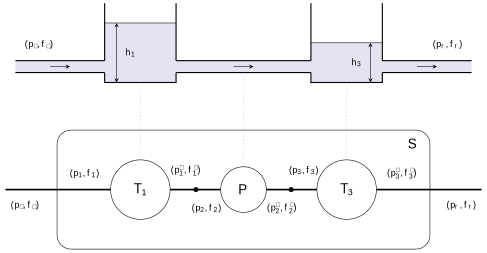
A systematic framework to study composition and compositionality theorems is offered by the double-operadic theory of systems (DOTS),1 which uses the two directions of a double category to capture both morphisms and couplings between systems. DOTS suggests a strategy to find compositionality theorems for verifying specs. Start from the idea, familiar from categorical logic, that the possible specs for (propositions about) a system are modeled as a fibration over the category of systems. Then lift the two-dimensional categorical structure comprising a DOTS from categories to fibrations. So far, this strategy has been executed for generalized Moore machines, recovering a version of assume-guarantee reasoning.2
We seek a Postdoctoral Researcher to further develop the theory of compositional specification and verification within the DOTS framework, focusing on the variable sharing paradigm of composition.3 The position is a mathematical one, but with an eye toward formalism that will be implementable in CatColab, our software platform for formal modeling. If you are excited to work with a first-rate team of mathematicians and research software engineers to help create the next generation of formal modeling tools, please consider applying for this position:
Call for applications: CA-2026-Postdoc-03
References
Footnotes
A first account of DOTS is by Libkind and Myers (2025). Several different but equivalent ways of presenting DOTS’ central mathematical concept, a loose module over a double category, were introduced by Lambert, Myers, and Patterson (2026). A book-length elaboration of DOTS is in preparation by Myers, Brown, Capucci, and collaborators. DOTS builds on and systematizes two major threads in applied category theory, one connecting double categories and systems and the other connecting operads and systems.↩︎
The DOTS work on compositional specs builds on the theory of design-by-contract for Moore machines due to Schultz, Spivak, and Vasilakopoulou (2020).↩︎
The variable sharing paradigm is also known as the “cospan approach” to composing systems. Baez (2026) presents a readable introduction to the cospan approach in double-categorical systems theory.↩︎